

Why Europe's independent IT professionals may need to rethink not only what they offer, but how they access the market.
An Unexpected Recommendation from LinkedIn
A few days ago, LinkedIn presented me with what it apparently considered an excellent match for my professional profile. As an independent IT programme and project manager, I naturally assumed that the recommendation would lead to an interesting freelance assignment. Instead, I found myself looking at a traditional permanent position at the Vienna University of Economics and Business.
I had to laugh. After all, I have spent many years working independently, and my professional profile makes that fairly obvious. Yet LinkedIn's matching algorithm had apparently decided that a permanent employment opportunity was precisely what I needed.
At first, I dismissed the recommendation as another example of an algorithm that had misunderstood its audience. But the more I thought about it, the more interesting the underlying question became. Was LinkedIn simply struggling to distinguish freelance assignments from permanent employment, or was this recommendation somehow reflecting a broader development in the IT project market?
Having worked as an independent IT programme and project manager for many years, I have experienced several market cycles. There have been periods when suitable assignments appeared almost effortlessly, followed by times when securing a new mandate required considerably more patience and persistence. What makes the current situation interesting, however, is that the difficulties many freelancers describe seem to exist alongside continued investment in technology and digital transformation.
Companies are still modernising their infrastructure, implementing cloud strategies, transforming business processes and introducing artificial intelligence. Yet many experienced independent professionals report that suitable assignments have become more difficult to secure.
This apparent contradiction made me curious enough to examine the available market data more closely.
The Freelance Market Is Under Pressure
The difficulties currently experienced by independent IT professionals are not merely anecdotal. Several German market studies published in 2026 indicate that the environment for freelancers has become significantly more challenging.
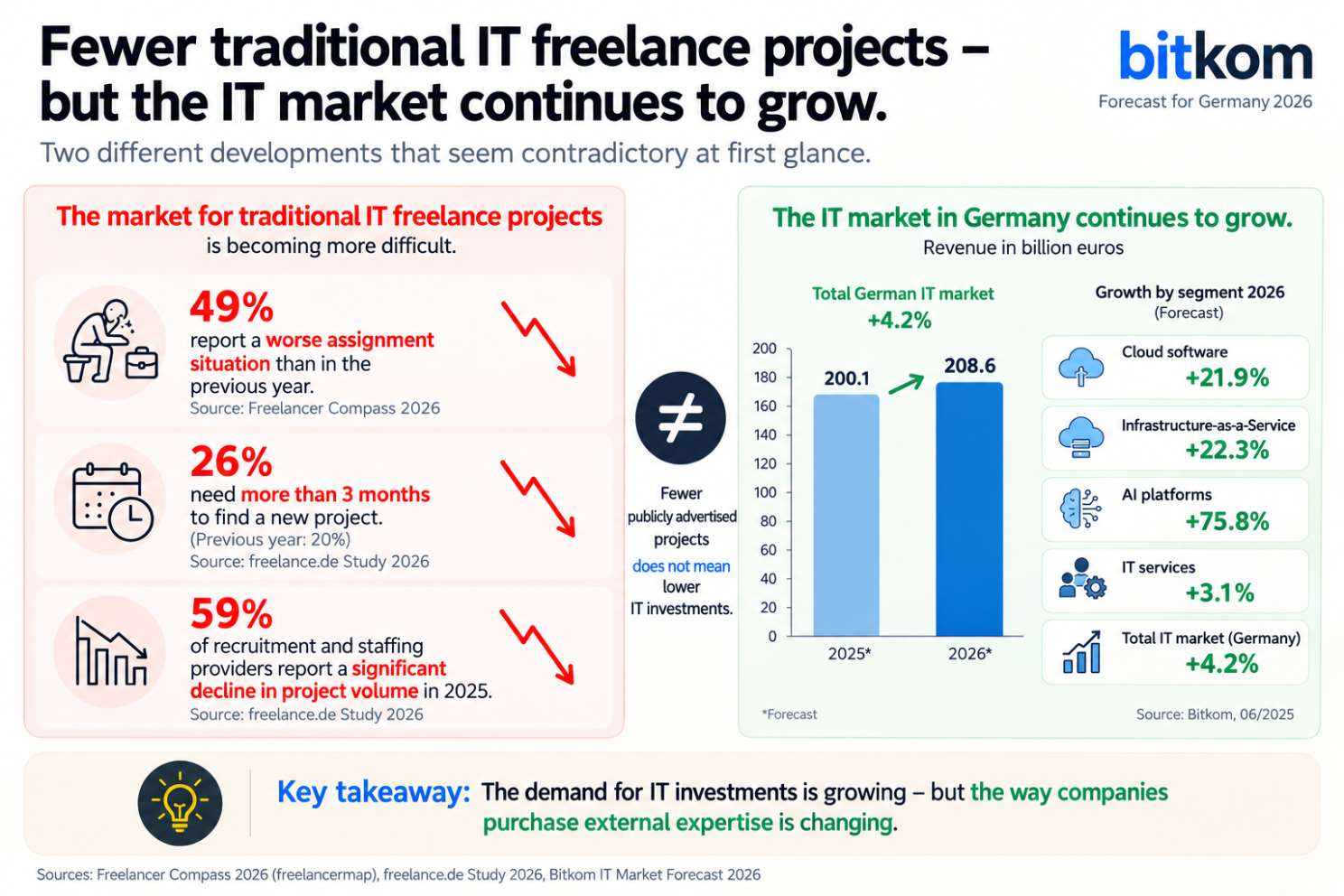
According to the Freelancer-Kompass 2026, 49% of respondents reported that their assignment situation had deteriorated compared with the previous year, while 43% had no secured utilisation at the time of the survey. The Freelancer Study 2026, published by freelance.de, paints a similarly difficult picture. Approximately 26% of respondents reported needing more than three months to secure a new assignment, compared with around 20% in the previous year. Only 3% managed to find a new assignment within a week.
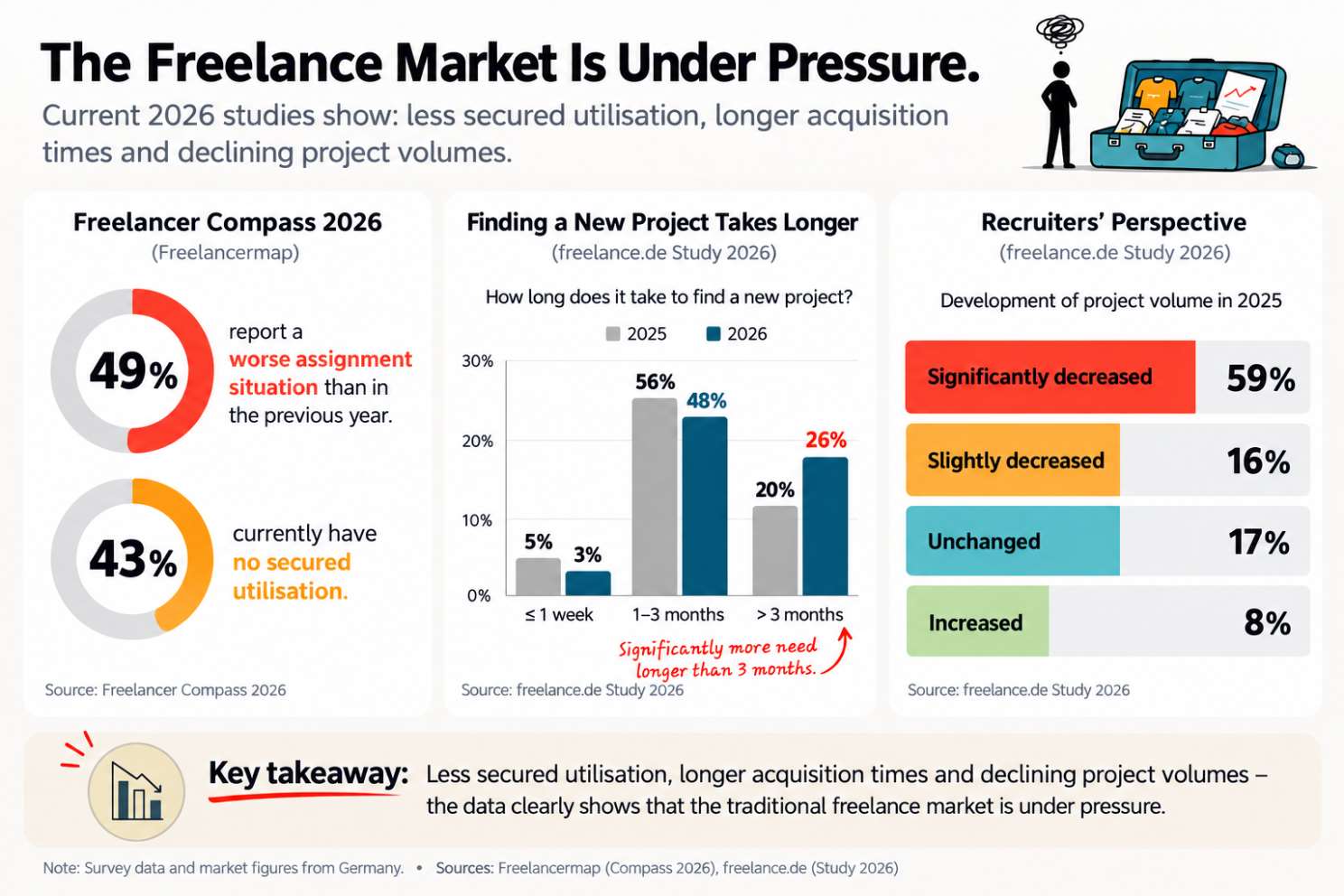
Current 2026 studies show: less secured utilisation, longer acquisition times and declining project volumes.
The situation appears challenging from the perspective of recruitment and staffing providers as well. According to the same freelance.de study, 59% of surveyed providers reported a significant decline in project volume during 2025, while another 16% experienced a slight decline.
These figures primarily describe developments in Germany and should not be interpreted as representative of the entire European market. Nevertheless, Germany is one of Europe's major markets for independent IT professionals, and the findings highlight challenges that are relevant to freelancers and recruitment companies operating internationally.
What particularly interests me is that these difficulties cannot simply be explained by a general lack of technological activity. If anything, the broader IT industry appears to be moving in a different direction.
The IT Industry Continues to Grow
According to the 2026 market outlook published by German digital industry association Bitkom, the German IT sector was expected to continue growing, with particularly strong momentum in areas such as cloud software, infrastructure-as-a-service, artificial intelligence and IT services.
This development is hardly surprising when considering the technological challenges facing European organisations. Companies continue to modernise their networks and data centres, migrate applications and workloads to cloud environments, strengthen cybersecurity, replace legacy systems and implement increasingly complex digital transformation programmes.
Many of these initiatives require specialist expertise that is not necessarily available within an organisation's existing workforce. Large transformation programmes often involve multiple technologies, external suppliers, regulatory requirements and organisational dependencies, creating a need for experienced professionals capable of coordinating both technical and business interests.
From that perspective, the demand for expertise should remain substantial. Yet the traditional market for independent IT assignments is experiencing considerable pressure.
The apparent contradiction becomes easier to understand once we distinguish between two fundamentally different things: the amount of money organisations invest in technology and the way they purchase the professional services required to implement that technology.
Growth in IT investment does not automatically translate into growth in publicly advertised freelance assignments.
That distinction may sound obvious, but I believe it is essential to understanding what is happening in today's market.
Perhaps the Work Is Not Disappearing. Perhaps the Way It Is Purchased Is Changing.
One possible explanation is that organisations are increasingly using different commercial and contractual models to obtain external expertise.
A few years ago, a company requiring an experienced IT programme manager might have published a relatively straightforward freelance assignment through a recruitment agency or specialist project platform Today, a similar requirement could form part of a larger consulting engagement, a managed services agreement, a framework contract or a broader transformation programme delivered by an external service provider.
In such cases, the underlying requirement for expertise may remain unchanged, while the opportunity becomes less visible to an independent professional searching traditional freelance platforms.
This does not necessarily mean that consulting firms or staffing providers are replacing independent contractors on a large scale. The available market data does not establish such a causal relationship, and it would be misleading to present that interpretation as a proven fact.
What we can observe, however, is that organisations have multiple ways of acquiring external expertise, and those procurement models influence where opportunities appear, how they are described and who can access them.
For freelancers, this creates a practical challenge. An assignment may exist without ever appearing on the platforms where they would traditionally expect to find it. The relevant opportunity might instead be managed through a preferred supplier, a specialised recruiter, an established consulting relationship or an internal procurement process.
Consequently, the visibility of freelance assignments may not accurately reflect the full extent of demand for external IT expertise.
This is particularly relevant in a European market where contracting practices, procurement structures and employment regulations differ significantly between countries.
Regulation and Contracting Models Influence Market Access
Germany provides an interesting example of how regulatory uncertainty can affect the market for independent professionals.
According to the Freelancer-Kompass 2026, 62% of respondents identified legal uncertainty surrounding the classification of false self-employment as the greatest risk to their independent professional activity. Approximately one in five respondents reported having experienced a situation in which an assignment did not materialise because of concerns related to this classification.
For international readers, the issue concerns the distinction between genuine independent contracting and working arrangements that may legally constitute employment, regardless of how the contractual relationship is described.
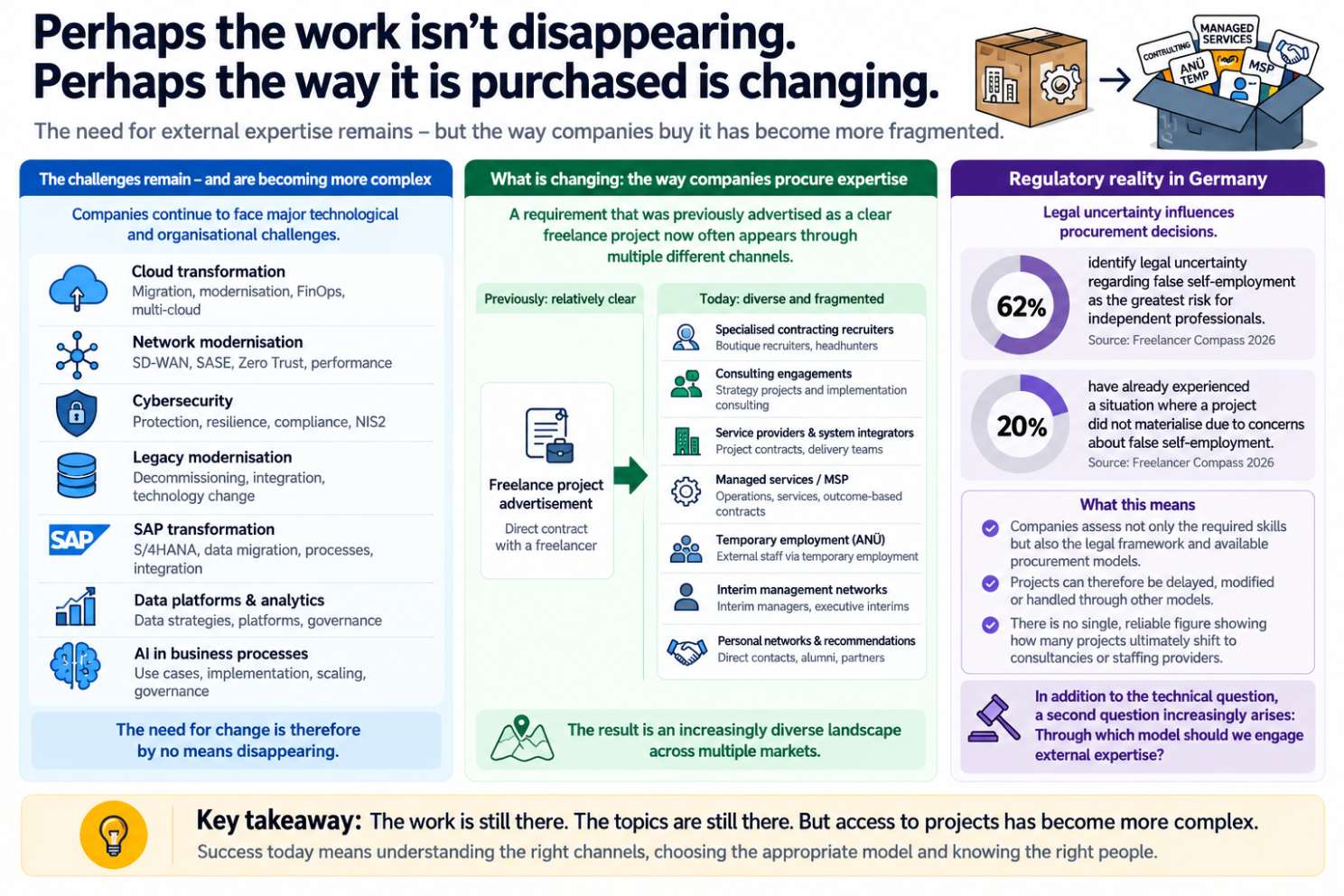
Companies engaging external professionals must therefore consider not only whether a person possesses the required expertise, but also whether the proposed contractual arrangement complies with the applicable legal framework.
This can influence the decision to engage an independent contractor directly or to use a different procurement or employment model. It does not prove that every affected assignment moves to a consulting firm or staffing provider, but it demonstrates that the availability of freelance opportunities depends on more than the demand for technical skills.
Across Europe, the situation becomes even more complex because individual countries apply different legal frameworks and contracting practices. A business relationship that is relatively straightforward in one jurisdiction may require a different structure in another.
For independent professionals working internationally, understanding these differences is increasingly part of understanding the market itself.
Specialisation May Be More Important Than Ever
Another aspect of the available research concerns the relationship between supply and demand across different professional disciplines
The Freelancer-Kompass 2026 suggests that some broad competency categories, including general project management, Scrum and JavaScript, face relatively high competition among available professionals. Other areas show a more balanced relationship between supply and demand, while specialised transformation capabilities remain relevant to organisations pursuing complex technological initiatives.
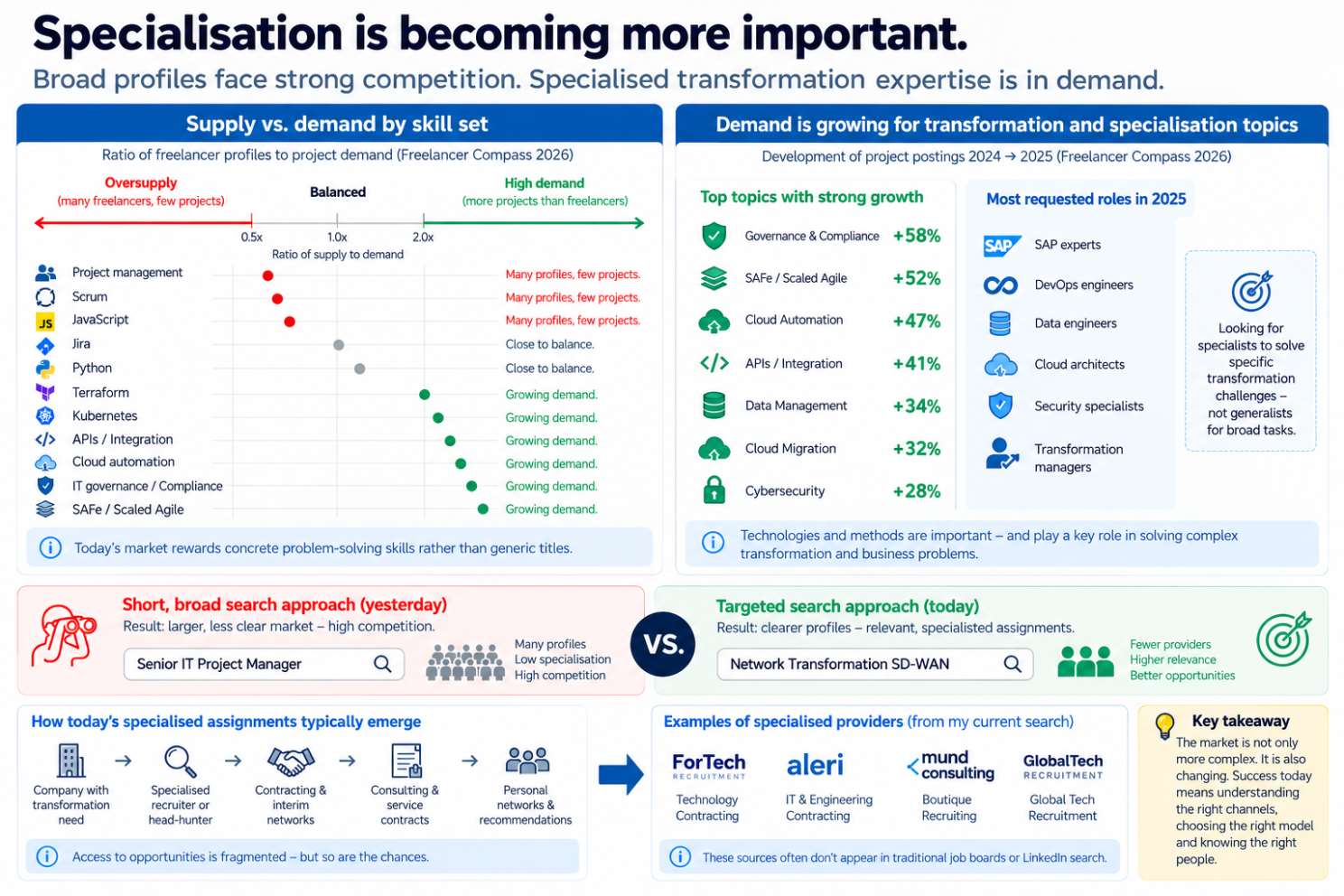
This observation resonates with my own experience.
If I describe myself simply as a senior IT project manager, I become one of many professionals competing within a very broad category. Although that description is technically correct, it says relatively little about the specific challenges I am qualified to address.
My professional background includes complex international IT programmes, infrastructure transformations, network and data centre initiatives, governance structures and large-scale organisational change. These experiences are considerably more specific than the generic label of project management.
When I focus my research on particular transformation challenges rather than broad professional titles, I begin to discover opportunities that might otherwise remain hidden.
A company modernising its critical infrastructure, consolidating international data centres or implementing a complex technology transformation may not necessarily advertise for a traditional project manager. It may instead seek expertise in transformation governance, infrastructure consolidation, programme delivery or enterprise technology modernisation.
The professional responsibilities may overlap considerably, even though the terminology used to describe the opportunity is different.
This leads me to believe that freelancers should increasingly consider how their expertise is positioned in the market. Rather than defining themselves exclusively through professional titles, they may benefit from communicating the business problems they are particularly well equipped to solve.
In a market where competition is intense, being recognised for a specific capability may be more valuable than being visible under a broad professional category.
LinkedIn Is an Excellent Network, but Not Necessarily a Precise Freelance Search Engine
My experience with the university position illustrates another challenge: the limitations of the tools we use to discover opportunities.
I consider LinkedIn an extremely valuable professional network. It allows me to maintain relationships, identify decision-makers, understand organisational developments and make my professional experience visible to a broad international audience.
However, I am considerably less convinced by its ability to distinguish reliably between the different commercial arrangements relevant to independent professionals.
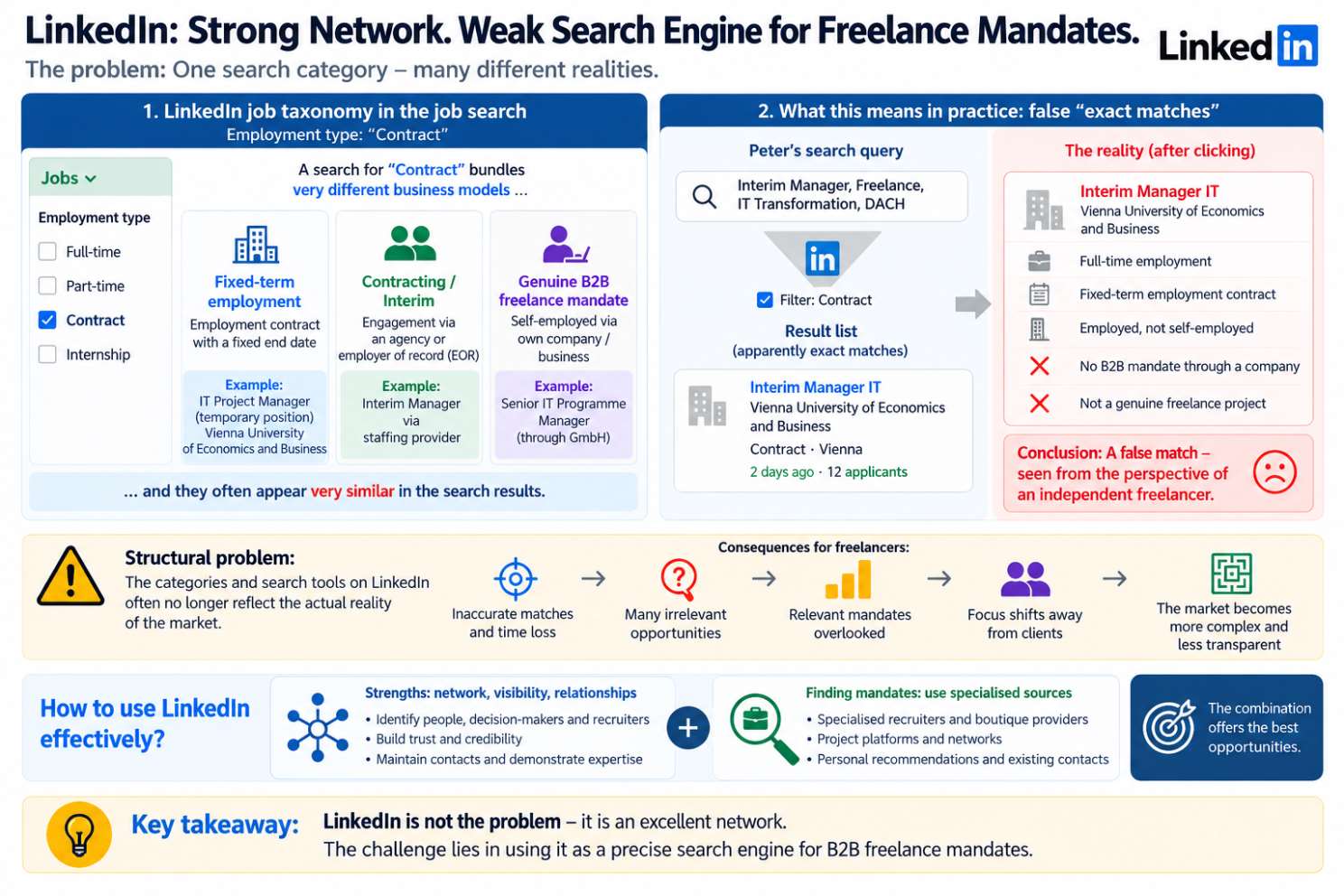
A position classified as “Contract” may refer to a fixed-term employment agreement, temporary staffing, a contracting arrangement or a genuine business-to-business assignment. For an independent consultant, these distinctions are fundamental because they affect everything from contractual obligations and commercial risk to taxation and professional independence.
Yet the terminology used by recruitment platforms does not always reflect these differences clearly.
This creates a situation in which a search algorithm can identify a technically relevant role while completely misunderstanding the type of business relationship the professional is seeking.
The recommendation I received from LinkedIn was therefore not entirely meaningless. The position may well have matched aspects of my
professional experience. It simply did not match the commercial model under which I operate.
That distinction matters because it highlights a broader problem with digital recruitment: matching professional skills is only one part of identifying a suitable opportunity.
A meaningful match must also consider the nature of the assignment, the contractual framework, the expected responsibilities and the professional's actual business model.
Otherwise, even sophisticated search tools can generate recommendations that look convincing on paper but are commercially irrelevant.
There Are Positive Signals, but Caution Is Still Appropriate
The market data from the first half of 2026 also contained some encouraging developments
According to figures published by freelance.de, approximately 30,300 projects were advertised on the platform during the first six months of 2026, representing an increase of 5.7% compared with the same period in 2025.
Project volume in the second quarter was reportedly 9.6% higher than in the corresponding quarter of the previous year.
These figures suggest that activity had begun to improve in certain parts of the market. However, a closer examination reveals a more complicated picture.
Compared with the first quarter of 2026, project volume declined again in the second quarter, while the proportion of IT-related projects on the platform also decreased,
It would therefore be premature to interpret the available figures as evidence of a broad and sustained recovery.
What they demonstrate is that the market continues to move, with different segments developing at different speeds.
My interpretation is that the freelance market may be undergoing a structural adjustment rather than simply waiting for the next conventional growth cycle.
That interpretation is not a forecast, and the available data does not establish exactly how the market will develop. Nevertheless, it encourages me to look beyond the question of whether the total number of publicly advertised projects is increasing or decreasing
I am increasingly interested in understanding where opportunities originate, how they move through the market and which organisations control access to them.
Rethinking the Way Freelancers Access Opportunities
One of the most important conclusions I have drawn from this analysis is that registering on additional project platforms is not necessarily the most effective response to a changing market.
Instead, I have started to distinguish between discovering a business opportunity and establishing access to the people or organisations behind it.
These are related activities, but they are not identical.
Specialised project platforms, boutique recruitment companies and targeted market research can help identify potential assignments. Professional networks, on the other hand, provide information about the organisations involved, their decision-makers, existing relationships and the broader context in which a project may arise.
This distinction changes how I approach business development.
Rather than relying exclusively on a platform to present a perfectly matched assignment, I try to understand the underlying business requirement and identify the people or organisations best positioned to discuss it.
In that context, LinkedIn becomes particularly valuable, not primarily as a job board, but as a professional relationship and market intelligence platform,
Recruiters also play an important role in this environment. Experienced recruitment professionals often possess market knowledge, established client relationships and access to opportunities that are not immediately visible through public searches.
For me, the objective is therefore not to replace recruitment partners or bypass established business relationships. It is to understand the market more effectively and develop stronger connections with the people who operate within it.
This approach requires more than technology. It also requires a clear understanding of one's own expertise, the ability to communicate relevant experience and a willingness to build professional relationships over time,
In a fragmented market, those relationships may become increasingly valuable.
Europe Is Not One Uniform Freelance Market
Although the original statistical analysis focused primarily on Germany, the underlying questions are relevant to independent IT professionals throughout Europe.
However, it would be misleading to assume that the same conditions apply equally across every country.
Austria, Germany, Switzerland, the Netherlands, the Nordic countries and the United Kingdom differ in their regulatory environments, procurement structures, recruitment practices and traditions of engaging independent professionals
Even the terminology used to describe external expertise varies considerably. Depending on the market, a professional may be described as a freelancer, independent contractor, interim manager, external consultant or contract professional.
These differences are more than linguistic. They can reflect fundamentally different contractual and commercial arrangements.
An international IT transformation programme might be advertised directly to independent contractors in one market, while a comparable requirement in another country could be managed through a consulting framework or a specialised recruitment provider.
For professionals seeking assignments across national borders, this means that expanding the geographical scope of a search is only the beginning.
It is equally important to understand which recruitment companies operate in each market, how assignments are distributed, which contracting arrangements are commonly used and where established professional relationships provide access to relevant opportunities.
My own experience has increasingly reinforced this perspective. As I have expanded my professional network beyond the German-speaking countries, I have become more aware of how differently markets can be organised, even when the underlying technological challenges are remarkably similar.
A cloud migration, infrastructure consolidation or international transformation programme may require comparable expertise in several countries. The route through which an independent professional gains access to that programme, however, can be entirely different.
This is one reason why I believe that understanding the structure of the market is becoming almost as important as understanding the technical requirements of the assignments themselves.
The Freelance Market Is Changing, Not Disappearing
After reviewing the available data and comparing it with my own professional experience, I find it difficult to support either of the two extreme interpretations frequently encountered in discussions about the freelance market.
The first suggests that everything is fundamentally fine and that independent professionals simply need to remain patient until the market recovers. The second suggests that the traditional freelance model is approaching its end.
Neither interpretation adequately reflects the complexity of the situation.
The difficulties are real. Competition has intensified in certain professional categories, assignment acquisition can take longer, regulatory uncertainty affects contracting decisions and traditional search platforms do not always reflect the commercial structures through which organisations obtain external expertise.
At the same time, European businesses continue to face substantial technological and organisational challenges. Digital transformation, infrastructure modernisation, cybersecurity, cloud adoption and artificial intelligence all create requirements for specialist knowledge and experienced programme delivery.
I therefore see little reason to conclude that the need for independent expertise has disappeared.
What may be changing is the way that expertise is identified, evaluated, contracted and integrated into larger business initiatives.
For freelancers, this creates a challenge that goes beyond maintaining technical competence. It requires a better understanding of how the market operates, a clearer articulation of individual strengths and a more deliberate approach to building relationships with clients and recruitment partners.
Perhaps the most important question is no longer simply where the next freelance assignment will appear.
Instead, independent professionals may need to ask where the demand for their particular expertise is emerging, how that demand is being translated into commercial opportunities and which relationships provide meaningful access to those opportunities.
That shift in perspective has certainly influenced the way I approach my own business development.
And it brings me back to the LinkedIn recommendation that started this entire investigation.
The algorithm was not necessarily wrong about my professional capabilities. It simply failed to understand the type of opportunity I was looking for.
Perhaps something similar is happening on a much larger scale in the freelance market.
We continue searching for familiar project titles on familiar platforms, while the actual demand for our expertise may increasingly appear through different channels, different commercial arrangements and different professional relationships.
Perhaps it isn't only the projects that have changed. The way to reach them has changed, too.
Sources and Context
This article is an English adaptation and European contextualisation of my original German market analysis published on 19 August 2026. The quantitative findings primarily concern Germany and reflect the information available at the time of the original publication.
The analysis draws on the Freelancer-Kompass 2026, the Freelancer Study 2026 published by freelance.de, project market statistics
from freelance.de, the 2026 IT market outlook published by Bitkom, and publicly available information on employment classification and contracting practices.
The discussion of wider European market dynamics represents my professional interpretation and experience rather than a comprehensive statistical study of all European countries
Original LinkedIn publication: The IT Market Is Growing. The Freelance Market Is Struggling. How Can Both Be True? (19 November 2026).