The more I train myself and reflect on performance, the more often I find myself asking a question for which I have yet to hear a truly convincing answer.
Why do we take certain principles for granted in elite sport, yet still regard those very same principles as weaknesses in professional life?
No Olympic champion would dream of training at their absolute limit every single day. Quite the opposite: anyone who constantly tries to make every training session as hard as possible will sooner or later become slower rather than stronger, more prone to injury, or, in the worst case, unable to train at all.
That is why managing training load, recovery, sleep, nutrition and deliberately planned rest periods have long been just as much a part of an athlete's programme as the training sessions themselves. Every elite athlete knows that the body does not grow stronger during exertion, but during the recovery that follows.
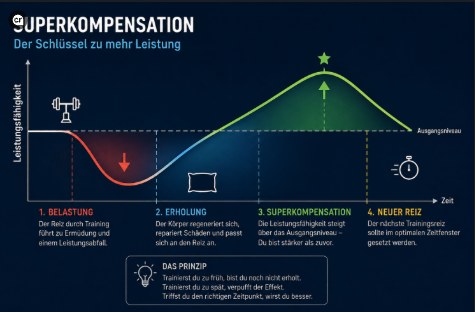
Simplified illustration of the principle of supercompensation. The actual pattern depends, among other factors, on the type and duration of training, the athlete's fitness level and their recovery. The graphic is reproduced from the original German publication.
Scientific background: Kenttä & Hassmén (1998); Meeusen et al. (2013); IOC Consensus Statement on Load in Sport (Soligard et al., 2016); Kellmann et al. (2018).
Interestingly, very different rules seem to apply in professional life.
Gaps in a CV are scrutinised. Taking a holiday during a period without an assignment can almost seem suspicious to some people. And anyone who regularly works late into the night or is constantly available is quickly regarded as particularly committed. Yet we would never recommend precisely this behaviour to a competitive athlete.
No coach would advise an athlete to cut back on sleep, skip meals and train to complete exhaustion every day in order to increase their chances of winning a gold medal. Everyone knows where that road leads: overtraining, declining performance, loss of concentration and often injuries as well.
So why do we believe that different biological laws somehow apply in business?
Our brains do not distinguish between a meeting room and a running track. Stress is still stress. Sleep deprivation is still sleep deprivation. Poor nutrition affects our ability to concentrate just as it affects an elite athlete's. The only difference is that we often cannot see our injuries on an MRI scan. They show up as exhaustion, chronic stress, burnout or simply a gradual decline in our ability to perform.
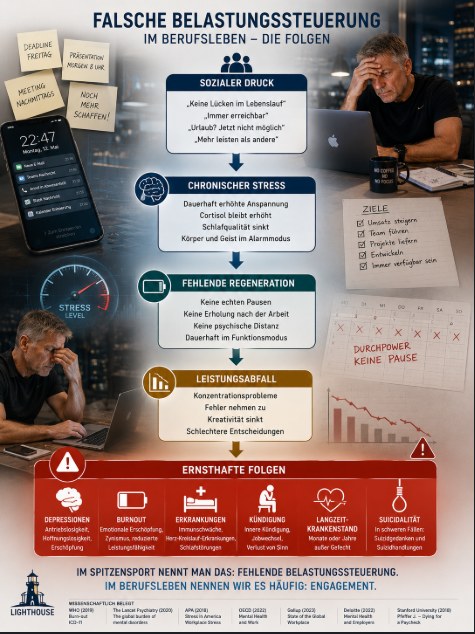
The original German infographic illustrates a possible progression from social pressure and chronic stress to insufficient recovery, declining performance and serious health consequences. It is an explanatory model, not an individual diagnosis.
Perhaps the underlying reason goes deeper than we care to admit.
Many of our decisions are driven not by genuine necessity but by concern about something that might happen. We work longer because we think it will make us indispensable. We sacrifice recovery because we fear appearing less committed. We avoid taking time off even when we could, because we worry that it might one day be viewed negatively on our CV.
There is a distinction I keep coming back to:
Danger calls for a response. Fear often arises from our interpretation of a possible future.
A burning house represents a real danger. So does an important client who is about to walk away. But many of the worries that dominate our working day exist only as possible future scenarios in our minds. And yet they often influence our behaviour more strongly than actual risks.
That is precisely why I find the comparison with elite sport so fascinating. There, managing performance is not a sign of taking it easy; it is an expression of the highest professionalism. Nobody would accuse a world champion of laziness for taking a scheduled recovery day. Everyone understands that the break itself is part of their success.
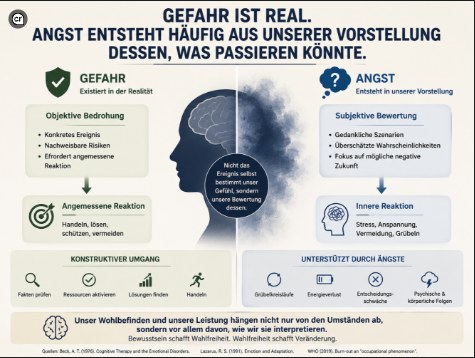
The original German graphic distinguishes an objectively present danger from subjective anticipation and interpretation. This is a conceptual distinction, not a claim that every fear is unfounded.
We would never expect an Olympic champion to train for twelve weeks without a rest day, sleep badly for months and still deliver personal bests every weekend. Any coach would intervene immediately. In business, however, we often applaud exactly this behaviour — as long as the numbers look good. Only when the person collapses do we suddenly start talking about health.
Perhaps it is time we started looking at companies through the same lens.
Not with the aim of keeping people at maximum utilisation for as long as possible, but of preserving their ability to perform over the long term. Peak performance rarely emerges when people are constantly operating at their limit. It arises when exertion and recovery are managed deliberately, when energy is taken just as seriously as productivity, and when leadership measures not only results but also creates the conditions that make those results sustainable in the first place.
Perhaps the difference between short-term productivity and sustainable peak performance lies precisely here: elite sport internalised this principle decades ago, while many companies still seem to believe that more workload must automatically produce better results.
An Olympic champion does not train according to their fears but on the basis of objective training-load data. In professional life, by contrast, we are remarkably often guided by fears that never materialise. We work longer, sleep less and sacrifice recovery — not because the danger is real, but because we believe it might become real.
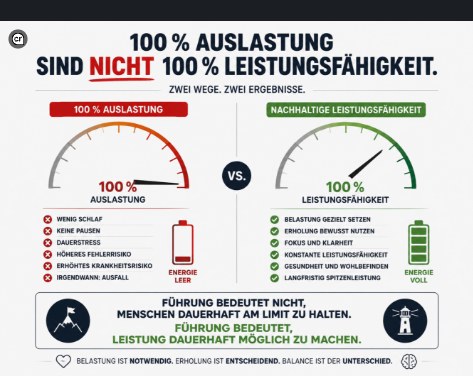
The original German infographic contrasts maximum utilisation with sustainable performance capability. Its numbers are illustrative, not a quantified empirical estimate.
I would genuinely like to know how you see it: Do we still have an understanding of performance in business that elite sport moved beyond long ago?